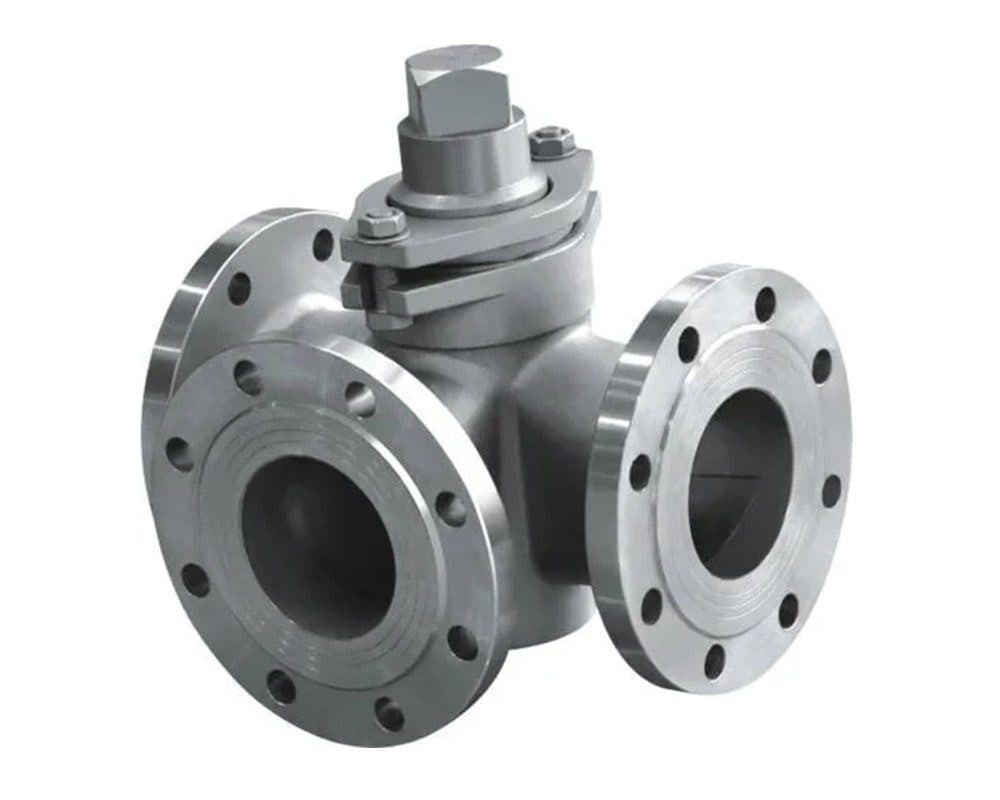
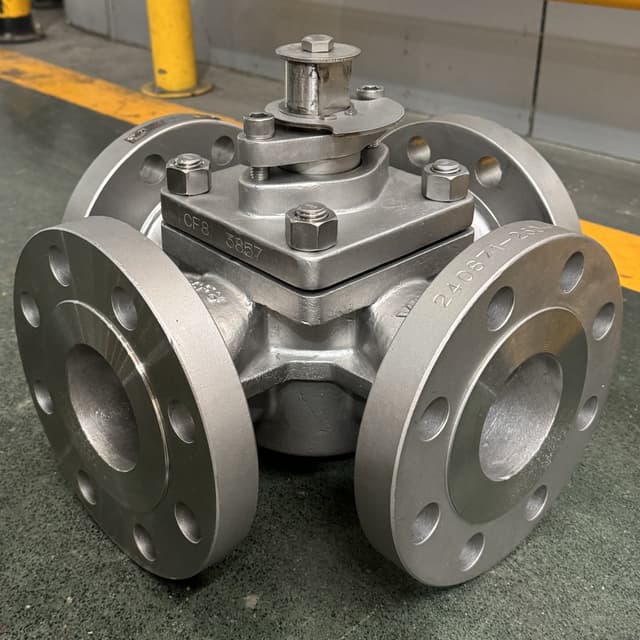
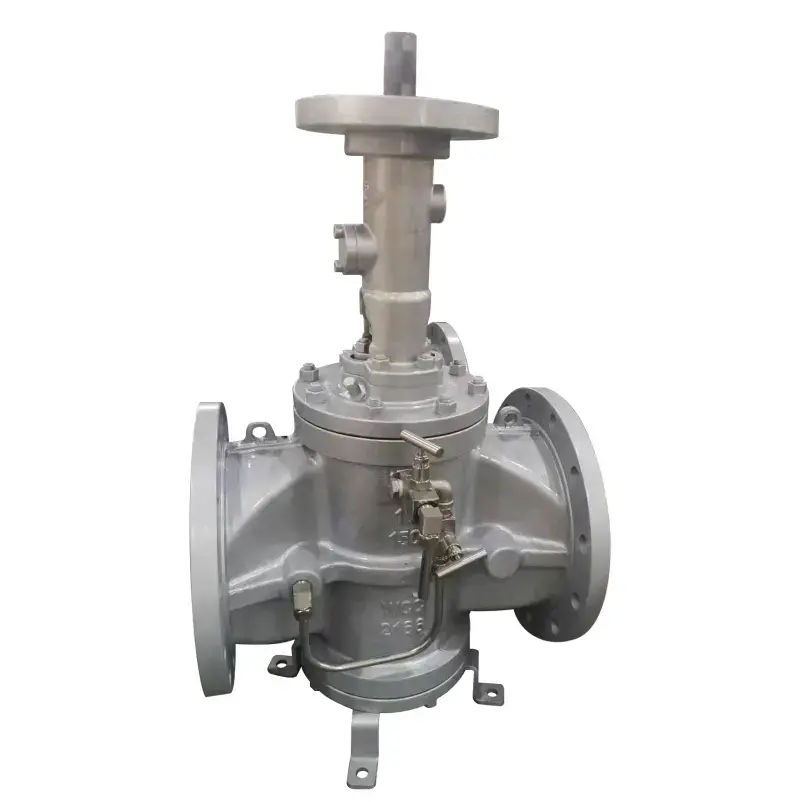
1. What is 3 way Plug Valve?
The 3 way Plug Valve is a high-precision fluid control device capable of multi-port distribution, mixing or diverting the process media. A closed two-position/way/manner ball key is an uncommon kind of valve in which the switch can be pivoted inside a solitary pitch length, StackSmallScale permitting for further developed stream step navigation actually like that visualized byCCD Tools multiple standard nodes. Designed for applications in which a combination of high energy efficiency and compact form factor are critical, this valve architecture combines the functions delivered by multiple two-way valves into a single unit to reduce total fittings and potential leak points within an instrument's overall fluidic network.
Such castings are fabricated using high-yield materials like cast steel WCB, or rustproof stainless-steel versions such as CF8 and also CF8M. These are frequently supplied as units lined with specialized lining, often made of a fluorine based coating or manufactured from high-performance polymer like PVDF and CPVC to help ensure oxidative durability in acid-base conditions. Scaffold conforms to international standards as per PN1. 0 to PN1. 6 MPa, offering a reliable solution for industrial loops with either standard or high-pressure level requirements.
2. How this Multi-port Device Works?
The operational principle of this distribution assembly relies on the rotation of an internal plug to manage fluid direction. Depending on the internal porting—typically categorized as L-port or T-port—the device can either divert flow from one inlet to one of two outlets or mix fluids from two inlets into a single discharge stream.
The core operational stages include:
- Actuation and Torque Transmission: The process begins with the activation of a manual handle or an automated system, such as the AT or GT series pneumatic actuator. This unit generates the necessary torque, which is transmitted through a high-strength stem, often made from 2Cr13 or 304 stainless steel, to rotate the internal plug.
- Port Alignment: As the plug rotates within the body, its internal flow channels align with the specific inlet and outlet ports of the valve. The precision-machined surfaces ensure that the transition between ports is smooth, minimizing pressure drops and turbulence during the switching phase.
- Sealing and Isolation: Once the plug reaches its designated position, the contact between the plug surface and the body seat provides a tight shut-off. Advanced packing materials like PTFE or flexible graphite are utilized around the stem to maintain external seal integrity. In hazardous environments, a bellows seal configuration may be employed to achieve zero-leakage performance.
3. Types of Multi-port Control Units
3.1 Material Classification and Properties
To accommodate various chemical and thermal requirements, these distribution units are produced in several configurations:
- Carbon Steel Series: Ideal for general industrial duty applications where high structural strength and durability are required in non-corrosive media with process temperatures up to 425° C
- Stainless Steel Series – These are crucial for food processing, pharmaceutical and special chemical industries that require withstanding oxidation or resistance to corrosion they use CF8 or CF8NavigatorMove.
- Options of fluorine-lined and plastic versions: Extremly corrosion resistant units for both seat materials, made with PFA or PTFE linings. Instead, for low-pressure chemical handling applications using solid plastic constructions such as PPH or CPVC provides compatibility with aggressive acids.
3.2 Actuation and Control Variants
- Pneumatic Execution Systems: Equipped with AT or GT series aluminum alloy actuators, these provide rapid switching and can be integrated into automated control loops for efficient plant management.
- Electric Motorized Systems: Using high-torque electronic actuators, these allow for precise positioning and remote feedback within a central control room, ideal for systems without access to compressed air.
- Manual Operation: A dependable mechanical interface for pipelines where frequency of operation is low and remote control is not a requirement.
4. Core Advantages of the Multi-port System
The integration of a dedicated 3 way Plug Valve system provides significant technical benefits that enhance the operational lifespan and safety of industrial infrastructure.
- Simplified Piping Design and Reduced Support Costs: The integration of multiple inlet/outlet flow paths into one body results in a smaller footprint and lighter weight installation, this also makes it easier to ship.
- Internal High Flow: The internal design is designed to maximize Cv, the flow capacity of gases and liquids that would pass through the ports with minimum restriction even at high viscosity.
- Low-maintenance: A top-entry or reduced-body design of the equipment enables easier inspection and replacement parts without removing it from line — less downtime at facility.
| Component | Example Materials | Performance Advantage |
|---|
| Main Body | WCB, CF8, CF8M, PVDF | High pressure rating and chemical compatibility |
| Internal Plug | 304SS, 316SS, Lined Steel | Smooth rotation and wear resistance |
| Drive Stem | 2Cr13, 304SS | Corrosion-resistant and high torque capacity |
| Stem Packing | PTFE, Bellows Seal | Reliable external sealing for hazardous media |
| Actuator | AT/GT Pneumatic | Rapid response and automated integration |
5. Industrial Applications
The 3 way Plug Valve is incorporated in range of specialized industrial sectors due to its strength and versatility:
- Chemical and Petrochemical Processing: These plants are important to transfer either the raw materials or finished goods among various storage tanks or processing reactors, particularly when aggressive reagents such as acids/alkalis are being handled.
- New energy and lithium battery: used for switching of precision handling of slurry liquid, electrolyte, etc has high requirements on reliable port switching properties.
- Water Treatment and Desalination: Used for controlling the flow of treated water & brine, well equipped to resist salt content or chemicals when using a plastic or lined version.
- Pulp and Paper Production: Necessary to control the flow of pulp fibers, chemicals, or other additives while supporting that we can safely turn offsystem for different process steps (turning on maintenance mode).