1. What is Trunnion Mounted Ball Valve?
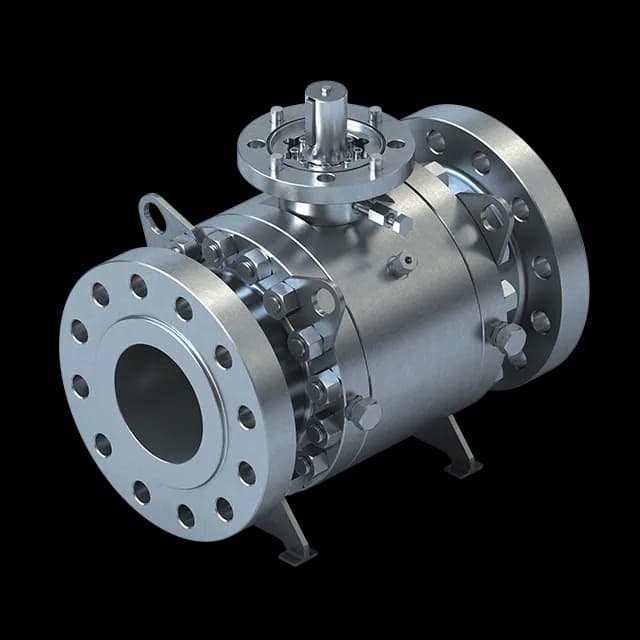
A Trunnion mounted Ball Valve is a robust flow control solution designed for high-pressure and large-diameter industrial piping systems. Unlike floating designs where the internal sphere is supported by the seats, this specific configuration utilizes a fixed ball mechanism supported by a top and bottom shaft (trunnion). This mechanical arrangement ensures that the sphere remains centered within the body, regardless of the upstream pressure, effectively transferring the hydraulic load to the valve body rather than the sealing seats. This design is particularly suitable for demanding services where operational reliability and seat longevity are critical.
As a core component of heavy-duty fluid automation, these rotary units are engineered to meet global industrial standards, including API 6D, ANSI, and GB. The architecture typically features a split-body or top-entry design, allowing for high structural integrity under extreme mechanical stress. Whether utilized in oil and gas transmission or high-pressure chemical processing, the trunnion-style architecture offers consistent performance and lower operating torque compared to floating alternatives. The equipment can be integrated with various drive systems, such as AT series pneumatic actuators or intelligent electric motors, to facilitate remote automated control.
2. How this Trunnion Rotary Device Works?
The operational principle of this equipment centers on a fixed-axis rotation that manages fluid flow through a ninety-degree turn of the internal sphere. Because the ball is anchored by trunnions, the sealing is achieved through a spring-loaded seat mechanism that moves against the stationary ball under the influence of line pressure.
The core operational stages include:
- Opening Phase: When the actuator transmits torque through the high-strength stem (often made of 2Cr13 or similar alloys), the internal sphere pivots from a position perpendicular to the flow to one parallel to it. This transition allows the media to pass through the full-bore body with a high flow coefficient (Cv) and negligible pressure drop.
- Closing and Sealing Phase: Upon receiving a signal to close, the sphere rotates ninety degrees back. The upstream pressure acts on the piston-effect seats, pushing them firmly against the sphere to ensure a bubble-tight seal. In high-performance models, a double block and bleed (DBB) function allows for the venting of the body cavity when the valve is in the closed position, providing an extra layer of safety.
- Fire-Safe and Anti-Static Protection: The design incorporates secondary metal-to-metal sealing surfaces that activate if the soft seals are destroyed by high heat. Additionally, internal grounding springs ensure that any static electricity generated by the rotating sphere is safely discharged to the body and the pipeline.
3. Types of Trunnion-style Control Units
3.1 Material Classification and Properties
To handle a wide range of industrial media and pressure classes (ranging from PN1.6 to PN42.0 MPa), these devices are manufactured from various high-performance metals:
- Carbon Steel Series: The normal structures for WCB or A105 offer high-mechanical strength suitable for general oil & gas services.
- Stainless Steel Series (CF8/CF3 or CF8M:316L) provides excellent corrosion resistance for highly corrosive chemical services and offshore applications.
3.2 Sealing and Actuation Variants
- Resilient Seated: Features seats made of PTFE, RPTFE, or Devlon, providing excellent sealing performance for gas and clean liquid services at moderate temperatures.
- Metal Seated: Utilizes hardened metal surfaces for the ball and seats, often coated with Tungsten Carbide, to manage abrasive slurries or high-temperature steam.
- Automated Assemblies: These units are frequently equipped with heavy-duty pneumatic actuators (AT/BW series) or motorized electric actuators, allowing for precise isolation managed through 4-20mA signals or digital protocols.
4. Core Advantages of the Trunnion System
The trunnion design provides several technical benefits that enhance the safety and efficiency of high-pressure industrial operations.
- Glycol Low Operating Torque: The above-mentioned, once again due to the support of beating weight, substantially reduced friction between balls and seats resulting in smaller sizes with associated actuators on a price point(cost).
- Self-relieving design The spring-loaded seats in the ball valve are automatically self-relieved, which can effectively prevent damage to the body caused by thermal expansion.
- Double Sealing: To ensure safety, both the upstream and downstream seats can independent of each other to reduce pressure mounted;
| Component | Example Materials | Performance Advantage |
|---|
| Valve Body | WCB, CF8, CF8M | High structural integrity for high-pressure ratings |
| Fixed Sphere | SS316 + Hard Chrome | Precision ground for low wear and high sealing |
| Sealing Seat | PTFE, Devlon, Metal | Reliable shut-off across various temperature ranges |
| Stem and Bearings | 17-4PH, Bronze | Durable support and smooth torque transmission |
| Actuator | Anodized Aluminum / Ductile Iron | High-torque automation for large diameter units |
5. Industrial Applications
This is why it has multiple critical sectors where its stability and high-pressure capability render necessary, hence one of many favorite valves across the industries:
- Oil and Gas Transmission: These ones are indispensable in long-distance pipelines for the transmission of oil, gas products as well as compressor stations that require isolated high-pressure systems with inherent safety advantages like double block & bleed.
- Petrochemical and Refining: Trunnion-mounted units are ideal for refining processes involving high temperatures and corrosive hydrocarbons, serving as reliable, long-lasting equipment with low maintenance requirements.
- Power Generation – The cooling water and high-pressure steam lines that require mechanical reliability to ensure plant safety as well as operational uptime.Parameters in use: Only for higher temperatures appropriated with metal seated models.